

As everyday fashion consumers, we tend to associate sizing with clothes — body garments, S/M/L labels, fitting rooms, size charts — while accessories are sold to us as a bunch of effortless, one-size-fits-all solutions. Fast fashion is rapid and anonymous: it doesn’t care about the length of your palm or your head circumference; the OS label is often the maximum information provided. So when you sit down to make a pair of mittens, it can feel unexpected to pause and demand precision for something so small, stretchy, and seemingly simple.
Bad news: yes, adult hands vary more than we assume, and you do need to take measurements to ensure proper fit.
Good news: the effort required is minimal — take just two measurements, and you’re good to go.
What and How to Measure
With a soft measuring tape, take the following measurements of your dominant hand (the one you use for fine motor tasks such as brushing teeth, crocheting, or writing):
- Hand circumference (HC): Measure around the widest part of the palm, thumb excluded, keeping the tape relaxed but snug.
- Hand length (HL): Measure from the hand base (where the wrist meets the palm) to the tip of your longest finger.
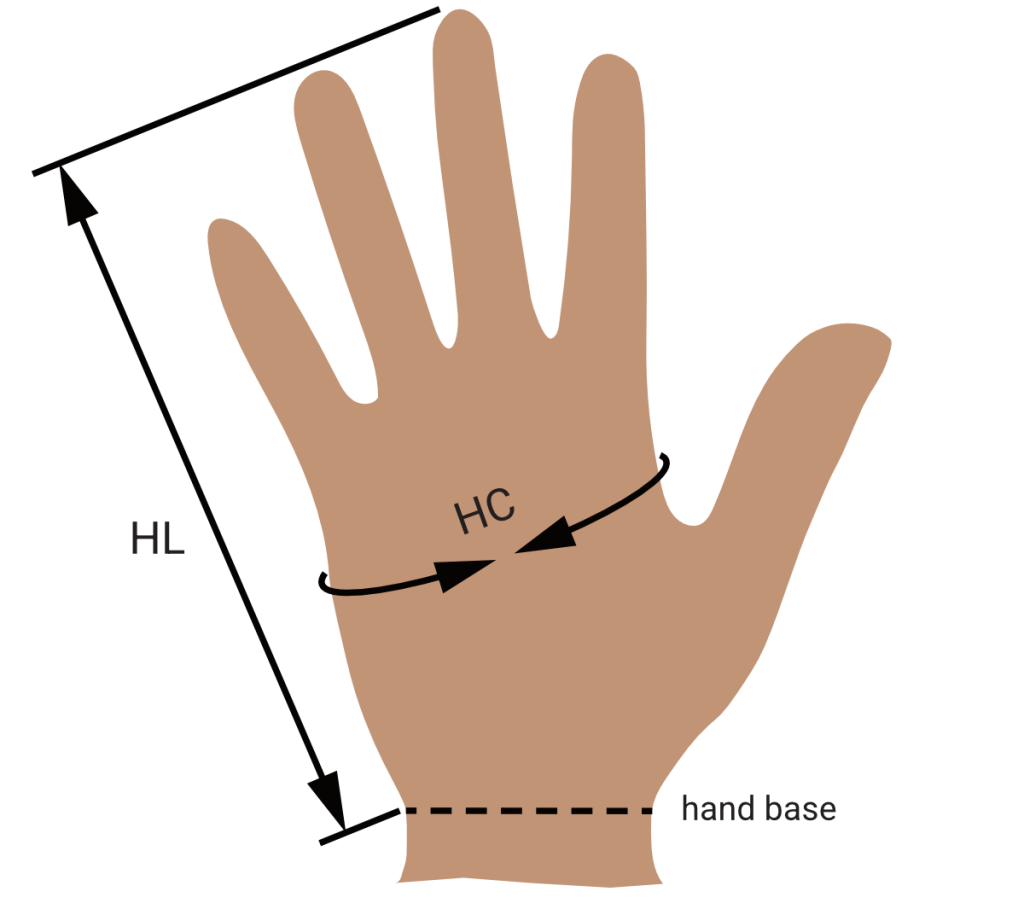
Most knitwear and pattern designers rely on these two measurements when shaping gloves and mittens. Below you’ll find the size chart I use in my own patterns — a sizing system developed from real hand measurements and applied consistently across my designs. It’s not a universal standard and it doesn’t claim to fit every hand perfectly; it’s a practical, well-tested reference meant to help you choose the right size quickly and confidently when working my patterns.
Kyla Zoran Hand Size Chart
| Size | HC (in) | HL (in) | HC (cm) | HL (cm) |
|---|---|---|---|---|
| Women’s S | 6¼–6⅞ | 6¾–7¼ | 16–17.5 | 17–18.5 |
| Women’s M | 7–7¾ | 7½–8 | 18–19.5 | 19–20.5 |
| Women’s L / Men’s S | 7⅞–8½ | 8¼–8⅞ | 20–21.5 | 21–22.5 |
| Men’s M | 8⅝–9¼ | 9–9¾ | 22–23.5 | 23–25 |
| Men’s L | 9½–10 | 10–10⅞ | 24–25.5 | 25.5–27.5 |
Note: If your measurements fall between two sizes or don’t align perfectly with a single row, choose the size based on the fit you prefer and use hand circumference as the main guide. For a snug fit, size down; for a more relaxed feel, size up. Knit and crochet fabrics are forgiving, and small variations are normal — this chart is a guide, not a rulebook.
If you don’t have a measuring tape
Use a ruler and a piece of non-stretching string (a ribbon, a strand of yarn, or even a strip of paper). Measure the hand length by placing the ruler on the inner side of your hand; wrap the string around your hand circumference and mark the spot where it overlaps, then unwrap and measure it against the ruler. If you don’t have a ruler, use a printable one found online.
If You Can’t Measure the Hand
When you’re making a gift and don’t want to ruin the surprise, it takes some creative tricks to minimize guesswork and maximize certainty.
1. Phone grip check
Measure the length and the width of their smartphone, then observe how their hand wraps around it. Some quick photos while they’re scrolling can be helpful.
2. Hand-on-hand comparison photo
Take a casual photo of your hands together — palms down on a flat surface, fingers relaxed, or one hand placed on top of another. Later, compare proportions using your own hand measurements as reference.
3. Trace-and-swap game
Suggest tracing each other’s hands “for fun” (kids do this instinctively).
Paper keeps exact scale — you can measure it later.
4. Cooking or crafting together
Rolling dough, chopping vegetables, holding tools — hands are flat and relaxed. These moments are ideal for visual estimation. Then compare against your own hand measurements.
5. Find an accomplice!
Sometimes, someone else can do the tricky part for you. A close friend, sibling, or partner can casually take measurements or snap a reference photo without raising suspicion. It’s often easier for a third person to turn a practical task into an innocent moment — and keep the surprise intact.
6. Surprise is overrated — ruin it and craft in peace
Consider involving the person you are making for in the process. Before you chase their hands with the tape measure, ask them if they want those mittens in the first place. There’s nothing more disheartening than working hard on something special and then discover that the recipient doesn’t like the color, or is allergic to the fiber, or, no matter how hard you’ve tried, the finished item still doesn’t fit as desired.
Take Time to Save Time
A small pause for measurement can change the entire making experience, turning uncertainty into calm confidence. When you know what you’re working toward, even simple mittens feel more intentional and satisfying to create. Keep this guide close — it’s meant to support your future projects.